


The world is full of artefacts, man-made objects. Due to the increasing pace of production, the existing is being replaced by the new ever more rapidly, and mountains of discarded things are accumulating. How can we live in a world where overconsumption poses a threat to ecological and social balance, and where sustainability is often used to promote consumption?
What is sustainable in human life?
The above question is central to my research into the textile legacy of the Dutch Benedictine monk and architect Dom Hans van der Laan (1904–1991).
During my many visits to the archive at St. Benedictusberg Abbey, a sense of sustainability strikes me. Sitting at the same table and on the same bench, designed by Van der Laan and crafted during his lifetime by a carpenter friend. Drinking black tea from the same cup that can be seen next to a model in an archive photograph from the last century. The black woolen habits worn everyday by the monks, scarcely changed in form since the founding of the Benedictine Order in the first century of the Western calendar. A monk explains that his habit is not his property, but entrusted for use until it wears out. And that takes an average of twenty years.
Philosopher Hannah Arendt argues that things are sustainable because they remain the same. Durability serves to stabilise life because, despite humanity’s ever-changing nature, we can relate to the same table, the same chair.
What can I learn from the clothing designs and related manuscripts in which Van der Laan seeks the essence of things? I am curious about the meanings of time and production within this monastic tradition, in which prayer and work are of equal importance. The methodology of my research, moving between the empirical and the empathic, unfolds as a process of re-making the clothing, as a bodily experience in active thinking.
A garment is a construction that provides protection as well as an identity to the wearer, and thereby a place in the world. A human dwelling.
I interpret the garment as a first house. A garment lies close to the skin and is, initially, situated in the intimate domain.
Dress no. 5 is not a historical reconstruction, but an interpretation based on my own body measurements.
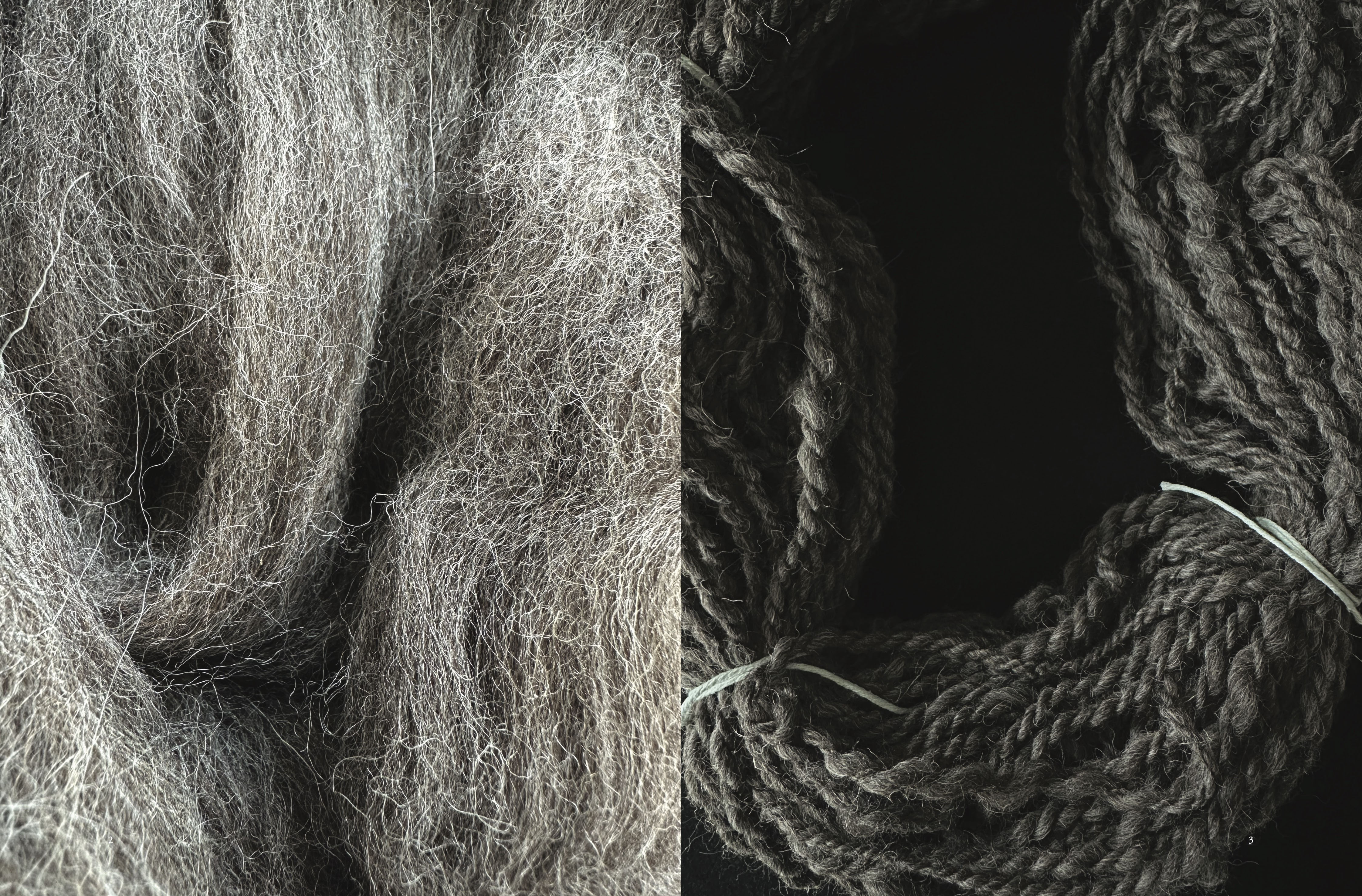
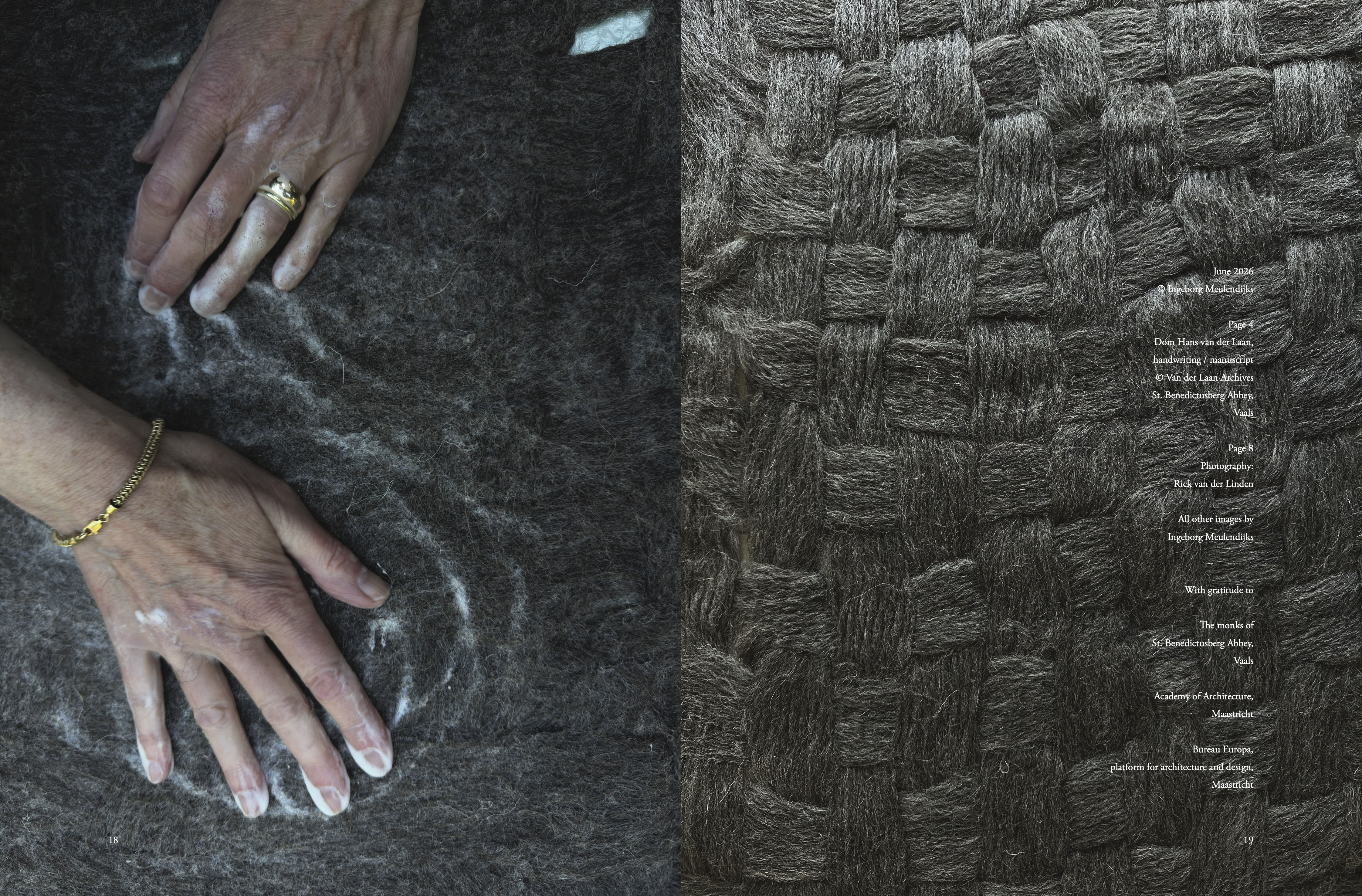
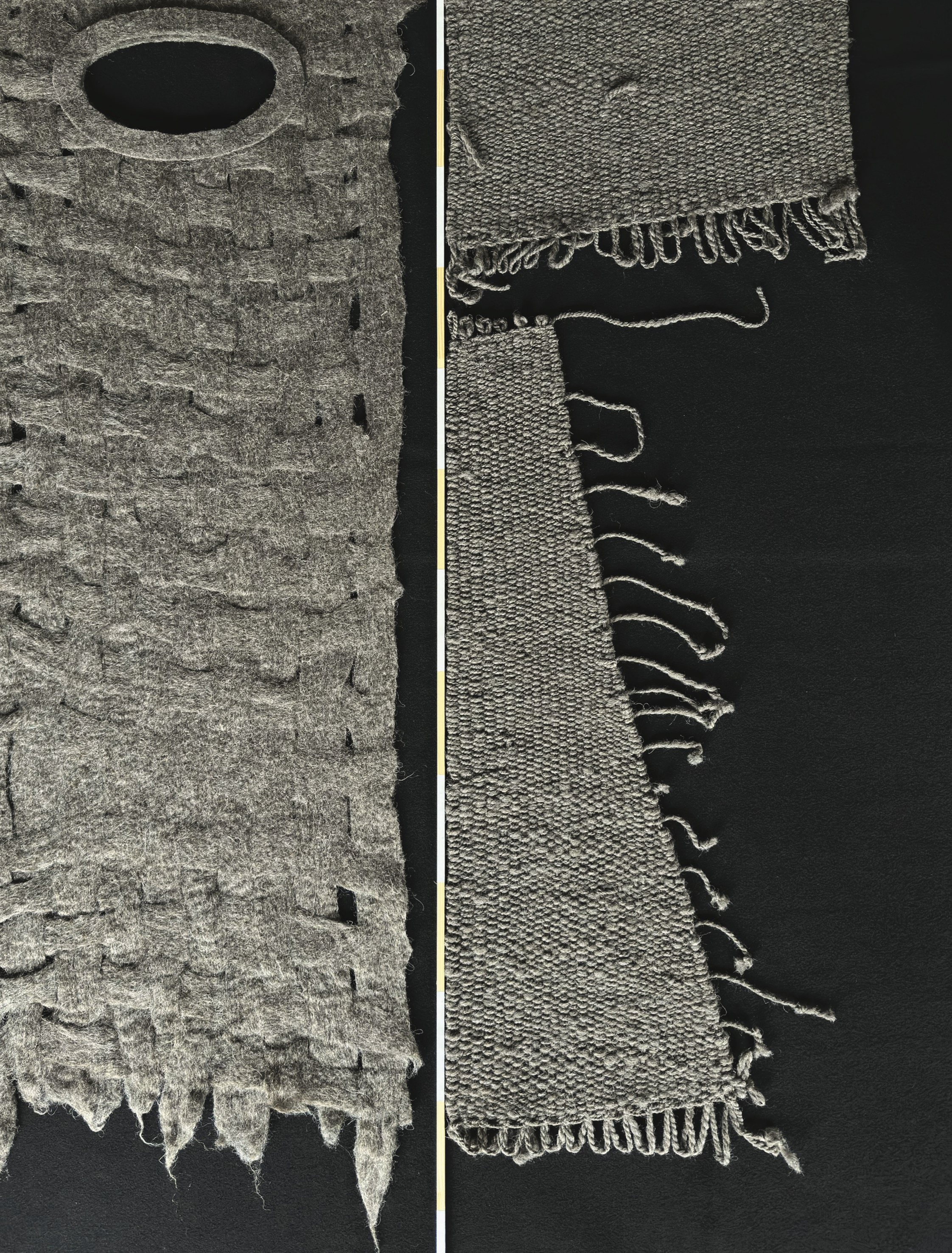
A hundred hours of practising in silence to spin, twist, weave and felt the sheep’s hair.
These manual skills are characterised by repetition and touch.
I haven’t done this kind of work before, it’s a beginner’s adventure guided by a sewing pattern drawn by Van der Laan. A pattern that acts as a floor plan, folding and adapting to the conditions of the environment, the material and the body.
The skin touches the sheep’s hair, worked by hands into a fabric.
Remembrances of the caring acts such as stroking, braiding, petting and combing the hair of living and dying loved ones.
Remembrances of the violent acts such as cutting and shaving hair, as a sacrifice, as a sign of resistance, humiliation, and release of an identity.
The manufacturing process is like a monk’s labour. Not a routine, but a realisation that every action is slightly different, imbued with a sense of presence in time.
The restless search for a meaningful experience or knowledge ebbs away into a sense of exploration and wonder at a single, elementairy action, like a sound in the space. The repetitions enable me to become at home with the action.
Can the dress, as a spatial structure, embody a ritual that transforms being-in-the-world into being-at-home?
Booklet publication ‘Dress No. 5’
by Ingeborg Meulendijks
i.c.w. Rick van der Linden (layout)
19 x 25 cm – 20 pages
June 2026
-
Dress No. 5
1703 grams of undyed Scottish sheep’s wool
2026
Ingeborg Meulendijks